Why most ICP discovery fails before it starts
The single biggest mistake early-stage founders make isn't building the wrong product. It's building for a customer they invented — and only discovering that two years and $200K later.
Every startup accelerator, every business book, every Twitter thread tells founders: "Define your ICP first." Great advice. But almost no one tells you how to actually find it — the operational, tactical process of identifying who your real ideal customer is before you waste time and money chasing the wrong people.
Instead, founders do one of three things:
They guess based on their own experience
"I used to be a marketing manager, so marketing managers are my ICP." This might be right. It might also be completely wrong — just because you had a problem doesn't mean your former peers are the ones willing to pay to solve it.
They copy a competitor's apparent audience
They look at who a competitor seems to target and assume that's the right ICP for them too. But competitors often target the wrong people as well — or they've evolved from their original ICP over years of iteration that aren't visible to you.
They survey their network
They send a Google Form to 50 people they already know and call it "customer discovery." The problem: your network is biased toward people like you, polite people who won't tell you the truth, and people who aren't actually in the market to buy.
All three of these approaches share one fatal flaw: they rely on what people say rather than what they do. Real ICP discovery means finding people who are already expressing pain, already searching for solutions, and already considering purchasing — not people you asked to imagine a hypothetical scenario.
The shift from assumption to signal
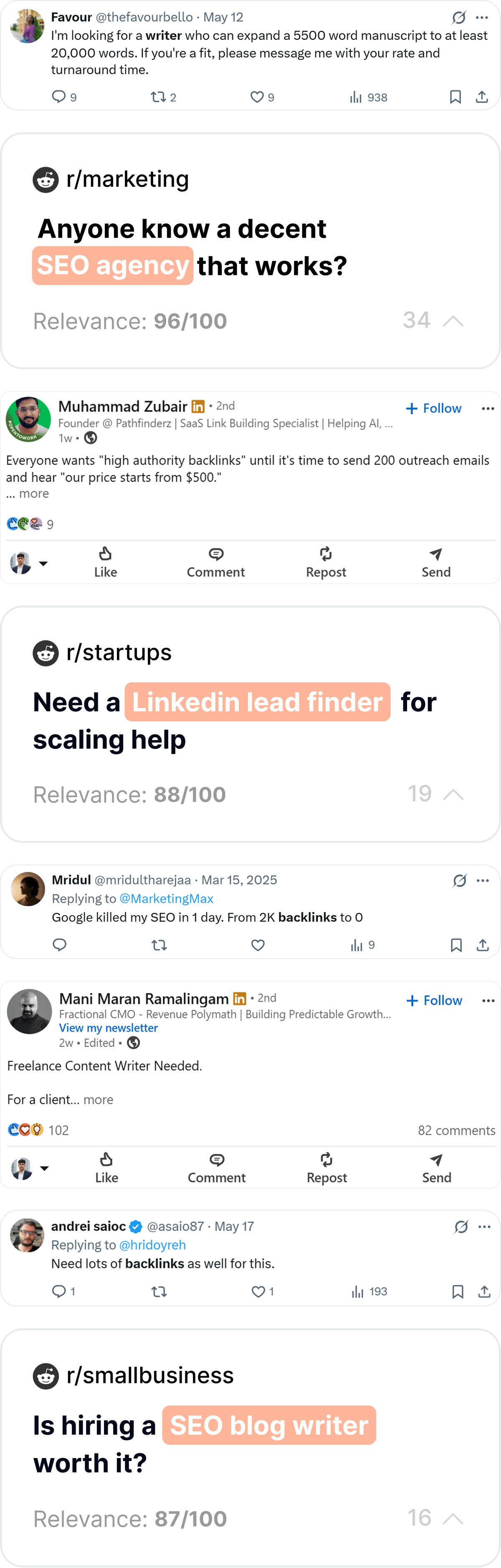
The most reliable source of ICP data isn't a survey. It's the internet. Right now, thousands of people who match your ideal customer profile are posting questions on Reddit, publishing LinkedIn articles about their struggles, tweeting frustrations about the exact problem you solve. They're leaving a real-time, public trail of breadcrumbs that tells you:
- What problem they have — in their own words, not yours
- How urgent the pain is — people post urgently when they really need help
- What they've already tried — giving you a map of your competitive landscape
- What they're willing to pay for — you can see when they ask about pricing, tools, or solutions
- Who they are — job titles, company sizes, industries, all visible in their profiles
This guide shows you exactly how to find and use those signals to discover your real ICP — and then convert them into your first paying customers.
Where your ideal customer actually hides
Your ICP isn't hiding. They're online every day, talking about their problems in public. The question is whether you know where to look.
Here's the mental model that unlocks ICP discovery: every person who buys a product first experiences a trigger event that makes them feel the pain acutely. That trigger event often drives them to search, post, or ask for help online. Your job is to be present at that moment — or at least to find those posts after the fact and identify who keeps posting them.
The 4 places your ICP reveals themselves
Reddit Communities
Reddit is the most honest social network on the internet. People ask raw, unfiltered questions because they're semi-anonymous. When someone posts "what CRM actually works for a 5-person team", they're a live buying signal — not a hypothetical customer.
LinkedIn Feed & Comments
LinkedIn shows you professional context that Reddit can't — job title, company size, seniority level, industry. When someone publishes a post about a frustration they're facing at work, their entire professional profile is attached to it.
X (Twitter) & #BuildInPublic
The #buildinpublic and #indiehacker communities on X attract founders who share everything — including their struggles. If your ICP is early-stage founders, X is a goldmine of real-time buying signals from people actively looking for tools.
Competitor Reviews & Alternatives
G2, Capterra, and ProductHunt reviews reveal exactly what your ICP hates about existing solutions. More importantly, people who post reviews are highly engaged buyers — they paid for something, used it, and had strong enough feelings to review it.
The highest-intent ICP signals come from people who are mid-problem — they've already recognized the pain, they're already looking for a solution, they just haven't found the right one yet. These are the people you want to find and reach first.
What your ICP looks like in the wild
Before you start searching, you need to know the difference between a high-intent ICP post and general noise. Here's how they differ:
❌ Low-intent noise
- "Anyone have thoughts on CRMs in general?"
- "What tools do you use? (general discussion)"
- "Interesting article about productivity"
- Generic questions with no urgency or context
- Posts by students or researchers, not buyers
✓ High-intent ICP signals
- "Struggling to track leads for my 3-person startup, what do you use?"
- "We just hired our 5th sales rep and our current tool is breaking"
- "Tried X, tried Y, nothing works — open to suggestions"
- Posts mentioning a specific trigger event or deadline
- Posts that mention budget, team size, or timeline
The key differentiator is context and urgency. High-intent posts give you enough information to understand the person's situation, their pain, and their proximity to making a decision. Low-intent posts are just casual conversations.
The 5 buying intent signals you need to recognize
Not every post from a potential customer is equally valuable. Learning to score intent is what separates founders who find 10 promising leads a week from founders who spend 10 hours on one.
These 5 signal types are ranked in order of buying intent — from the most urgent to the most early-stage. When you're scanning social platforms for ICP data, weight your time toward the top.
Signal 1: Active alternative-seeking ("I'm switching from X")
When someone says "We're leaving [Competitor] and looking for alternatives", they are a near-certain buyer within days or weeks. They've already paid for something, they're unhappy, and they have budget allocated. This is your highest-priority signal. Example: "We've been using HubSpot for 6 months and it's overkill for our stage — what do smaller teams use?"
Signal 2: Explicit problem statement with urgency
Posts that describe a specific, time-bound problem they haven't solved yet. The urgency is the key — phrases like "we launch in 3 weeks", "our investor asked for this last week", or "I need to have this figured out by Q3" indicate a real deadline driving the search. These buyers will act fast.
Signal 3: Comparison requests ("X vs Y — which is better?")
When someone is comparing specific tools or approaches, they're in the evaluation stage. They're not casually curious — they've narrowed it down. If you're one of the tools being compared (or can position yourself as an alternative), this is a high-value entry point into their decision process.
Signal 4: Recurring frustration with the status quo
Someone who consistently posts about the same problem across multiple threads over time is building up to a purchase. They haven't acted yet because they haven't found the right solution. If you appear in their feed with a compelling response, you can catalyze the decision they've been slowly building toward.
Signal 5: Early-stage problem awareness
Posts where someone has just begun to recognize they have a problem and is starting to learn. These are the lowest-intent signals but the highest-volume — and they tell you how your ICP thinks and what language they use. Use these for content strategy and keyword mining, not for immediate outreach.
When you find a post, ask these three questions: Does this person have a specific problem (not a general question)? Do they have urgency (a deadline, a trigger event)? Do they have budget signals (they've paid for something before, they mention team size, or they're asking about pricing)? Three "yes" answers = highest-priority lead. Two = follow-up. One = monitor only.
Finding your ICP on Reddit
Reddit is the single best platform for ICP discovery at the early stage. Here's the complete playbook for mining it systematically.
Step 1: Build your subreddit map
Before you search, you need to know which subreddits your ICP actually inhabits. Most founders only know the obvious ones (r/startups, r/entrepreneur). But the best ICP signals are often in the specific communities your customers use — not the general ones.
To find your subreddit map, start with this framework:
Role-based subreddits
Where your ICP congregates based on their job title or function. Examples: r/marketing, r/sales, r/devops, r/ProductManagement, r/CustomerSuccess. These communities discuss problems in the context of their work — which is exactly where buying intent lives.
Industry-based subreddits
Where your ICP goes based on their industry. Examples: r/ecommerce, r/legaladvice, r/realestateinvesting, r/healthcareIT. If your product solves an industry-specific problem, these subreddits have extremely concentrated ICP density.
Stage-based subreddits (for B2B/founder tools)
Communities around business stage: r/startups, r/SaaS, r/indiehackers, r/smallbusiness, r/Entrepreneur. These contain your ICP if you serve early-stage companies.
Tool-specific subreddits
Subreddits for tools your ICP already uses — like r/hubspot, r/salesforce, r/notion, r/zapier. People posting in these communities are confirmed buyers of software in your category. Even better: people complaining in these communities are actively looking for alternatives.
Step 2: The keyword mining method
Once you have your subreddit list, you need to search systematically for posts that match your problem space. Use Reddit's search (or Google with site:reddit.com) with these categories of keywords:
PAIN KEYWORDS (highest intent):
"struggling with [problem]"
"can't figure out [problem]"
"frustrated by [problem]"
"anyone else dealing with [problem]"
"I hate how [tool/process] works"

ALTERNATIVE-SEEKING (highest intent):
"looking for alternatives to [competitor]"
"switching from [competitor]"
"[competitor] is too expensive"
"what do you use instead of [tool]"
"[competitor] doesn't do X, what should I use"

EVALUATION KEYWORDS (high intent):
"[Tool A] vs [Tool B]"
"best [tool category] for [company type]"
"recommendations for [problem]"
"what tools does your team use for [X]"

PROBLEM DEFINITION (medium intent):
"how do you handle [problem]"
"what's your workflow for [X]"
"anyone solved [specific challenge]"
Step 3: Profile every person you find
Every high-intent post is also an ICP data point. When you find someone posting about your problem space, don't just note the post — profile the person:
- Check their post history — what else do they talk about? What other tools do they use? What other problems do they mention?
- Note what subreddits they're active in — this tells you where more of your ICP hangs out
- Look for their professional context — sometimes Reddit bios or post histories reveal job titles and industries
- Save the exact language they use to describe their problem — this is your future marketing copy
- Note how long ago they posted — recent posts (under 2 weeks) are still actionable for outreach
After profiling 20–30 Reddit users who match your problem space, look for patterns: What job titles keep appearing? What company sizes? What tools do they mention? What language do they repeat? These patterns are your ICP. You're not defining it — you're discovering it from the data.
Step 4: Track subreddits over time
One-time searches are useful. Ongoing monitoring is transformative. Set up tracking for your key subreddits and keywords so you see new posts as they appear. The best outreach happens when you respond within hours of a high-intent post — when the person's problem is fresh and they're actively looking for help.
This is where manual processes break down. Monitoring 8–12 subreddits across multiple keyword sets, every day, is a full-time job. EarlyCustomers.com monitors your key subreddits in real-time and alerts you the moment a high-intent post appears — so you can respond within the window when it matters most.
Finding your ICP on LinkedIn
LinkedIn gives you something Reddit can't: a complete professional profile attached to every signal. When someone posts a problem on LinkedIn, you know exactly who they are, where they work, what their title is, and how to reach them directly.
LinkedIn search as ICP research
Most people use LinkedIn search to find people to message. Use it instead to find patterns — the attributes of people who keep expressing your problem.
Search by keyword in posts (not profiles)
Switch LinkedIn search to "Posts" mode and search for your problem keywords. "struggling with lead generation", "looking for a CRM for small team", "our outreach isn't converting" — these searches surface people currently expressing the problem, not just people with the right job title.
Profile the authors of high-intent posts
Every post has a full profile attached. Click through on every high-intent post and note: job title, company size, industry, seniority, how long they've been in the role, their location. After 20 profiles, you'll see patterns that define your ICP with far more precision than any persona exercise.
Mine the comments for second-order ICP data
Don't just look at who posts — look at who comments. When someone posts a problem and 15 people comment agreeing they have the same issue, those commenters are just as much your ICP as the original poster. And they haven't been reached out to yet.
Search company pages of your best-fit leads
When you find a great ICP match, go to their company page and look at who else works there with similar titles. Growing companies often have multiple people experiencing the same problem — and only one of them may have posted about it.
LinkedIn Sales Navigator for deeper ICP research
If you have access to Sales Navigator, it unlocks powerful ICP research filters:
- Company headcount filters — isolate the exact company sizes that match your ICP (e.g., 10–50 employees)
- Recent role changes — people who just started a new job are in a "new broom" buying mindset and more open to tools
- Posted on LinkedIn in last 30 days — filter for active users who are engaging with content (higher intent than passive lurkers)
- Growth rate filters — growing companies have the budget and urgency that shrinking companies don't
- Keywords in posts + title filters — combine "CTO" with "struggling with" in their recent posts to find technical decision-makers mid-problem
Build a list of 50 LinkedIn profiles that you believe match your ICP. Then score each one: How much do they post? How much do they engage with your problem space? How similar are their backgrounds to your existing customers (if you have any)? The profiles with the highest scores define the center of gravity of your real ICP.
Finding your ICP on X/Twitter
X has a different ICP discovery dynamic than Reddit or LinkedIn. The signal-to-noise ratio is lower — but when you find a signal, it's often from someone at exactly the right moment to buy.
The X advantage: real-time intent
X is the most real-time of all three platforms. When someone tweets "I've tried 4 different CRMs and none of them do X correctly — anyone have a better option?", they're posting in the heat of frustration. They want an answer today. The window for outreach is hours, not days.
This real-time dynamic makes X uniquely valuable for ICP discovery if you're monitoring it consistently — but nearly worthless if you're checking manually once a week.
Advanced X search operators for ICP research
Find frustrated users:
"[problem] -filter:links" — removes promotional links, surfaces real conversations
"[problem] min_faves:5" — posts that resonated (your ICP agreed with them)
"[competitor] frustrated OR angry OR switching" — alternative-seekers

Find the #buildinpublic community (great for B2B/SaaS tools):
"#buildinpublic [your problem keyword]"
"#indiehacker looking for OR struggling with"
"#SaaS [problem] anyone"

Find by job title + problem (X doesn't have LinkedIn-style filters, but):
"(founder OR CEO OR CTO) [problem keyword]"
"from:[username]" — search a specific person's history for problem signals

Time-based (for real-time outreach):
Add "since:2026-06-01" to only see recent posts
Sort by "Latest" not "Top" to see current activity
Community mapping on X
Like Reddit has subreddits, X has communities and hashtag clusters. Your ICP likely gravitates toward a few:
- #buildinpublic — founders building startups in the open; extremely concentrated early-stage SaaS buyer ICP
- #indiehacker — bootstrapped founders, solopreneurs; high intent to purchase tools that solve specific problems
- #growthhacking / #growth — marketers and growth teams actively experimenting with acquisition channels
- Industry-specific hashtags — #proptech, #legaltech, #healthtech, #fintech all have concentrated professional communities
- Tool-specific communities — #notionhq, #salesforce, #hubspot users who are actively using (and complaining about) competitive tools
On X, if you respond to a high-intent post within 2 hours, you're often the first thoughtful reply. After 6 hours, the poster has usually gotten enough responses and moved on. Monitor your key keywords in real-time — or use EarlyCustomers.com to get instant alerts when a high-intent post matches your ICP profile.
Validating your ICP with discovery calls
Social listening gives you hypotheses. Discovery calls give you validation. You need both — and you need to run them in the right order.
The discovery call as ICP research, not sales
Most founders treat discovery calls as sales calls in disguise — they're trying to pitch while pretending to listen. This is the wrong frame, especially early. Before you have 10 paying customers, every discovery call should be primarily a research exercise. You're not trying to close; you're trying to understand.
The goal of each call is to answer five questions:
"What triggered you to look for a solution now?"
This reveals the trigger event — the thing that made the pain acute enough to act on. This is gold for your ICP definition: if 8 out of 10 people give the same trigger event, you've found the circumstance that defines your highest-intent buyer moment.
"What have you tried before, and why didn't it work?"
This reveals your competitive landscape and what gaps exist in the market. It also tells you what your ICP's "minimum viable solution" looks like — the threshold they need you to clear to be worth switching to.
"Walk me through what a bad week looks like with this problem"
This open-ended prompt gets people to describe their pain in their own words — the exact language you'll use in your copy, your outreach, and your positioning. Don't help them finish their sentences. Let them find the words themselves.
"Who else in your organization does this affect?"
This reveals the buying committee — who else needs to be convinced for a purchase to happen. It also tells you if there are influencer personas adjacent to your main ICP who matter in the sales process.
"If this problem were solved tomorrow, what would be different?"
This reveals the outcome your ICP is actually buying — not the feature, but the result. Your ICP doesn't want a CRM; they want to never lose track of a warm lead again. Don't sell the feature. Sell the outcome they described here.
When to update your ICP based on call data
Run at least 10 discovery calls before making any significant change to your ICP definition. One call that contradicts your hypothesis doesn't mean you're wrong — it means you've encountered an outlier. Ten calls that contradict your hypothesis means your ICP is wrong and needs revision.
Keep a running document with these columns for each call: Name / Role / Company Size / Trigger Event / Language Used / Outcome Desired / Deal-Breakers / Would Pay?
After 10 calls, the patterns in this document are your validated ICP.
Competitor ICP mining — the unfair shortcut
Your competitors have already done years of ICP discovery. You can compress that learning into days by systematically mining their public data.
Where competitors reveal their ICP (without knowing it)
Competitors leave ICP clues everywhere if you know where to look:
- Their customer testimonials and case studies — every testimonial shows you a real customer's job title, company, and the specific problem they solved. Read 20 testimonials from your top competitor and you've mapped their ICP.
- Their G2 / Capterra / Trustpilot reviews — public reviews show who's buying, why they bought, what they liked, and what they hated. The "what I hated" section is your product opportunity.
- Reddit threads mentioning competitors — search "[competitor name]" on Reddit. You'll find people complaining, switching, and recommending alternatives — all high-intent ICP signals that are ready to engage with you.
- Their job postings — the industries, company sizes, and technical requirements in their job ads reveal their customer base and growth direction.
- Their pricing page segmentation — the tiers and features on a competitor's pricing page reveal which customer segments they're optimizing for.
The highest-intent leads you'll ever find are people actively switching away from a competitor. These people have budget (they're already paying), they're dissatisfied (they won't need convincing they have a problem), and they're in motion (they're looking right now). Search "[competitor] alternatives" and "[competitor] review" on every platform weekly.
The review mining framework
| Review Section | What It Tells You | ICP Insight |
|---|---|---|
| "What do you like best?" | What your ICP values most | Must-have features for your build list |
| "What do you dislike?" | Gaps in the market you can fill | Your product positioning opportunity |
| Star rating + job title | Which personas are satisfied vs frustrated | Which segment to target first |
| "Problems solved" | The outcomes buyers care about most | Your marketing messaging |
| Company size in reviewer profile | Actual customer segment distribution | Where competitor is winning (and vulnerable) |
From ICP discovery to your first paying customer
All the discovery in the world is worthless if it doesn't lead to revenue. Here's how to close the loop between finding your ICP and converting them.
The 3-step activation sequence
Engage before you pitch
When you find a high-intent post from your ICP on Reddit, LinkedIn, or X — don't pitch. Reply with genuinely useful information. Answer their question thoroughly. Offer something they couldn't find elsewhere. Do this for 3–5 posts from the same person before you even think about a direct message. By then, they know who you are.
DM with context, not a pitch
When you do reach out directly, reference the specific post that showed you they were a fit. "I saw your post about struggling with lead tracking on r/SaaS last week — I've been building something specifically for that problem and wondered if you'd want to see it." This is not a cold DM. It's a warm, relevant one.
Offer the discovery call as value, not a sales call
"I'd love 20 minutes to walk you through how we're solving this — and if it's not a fit, I'll share everything we've learned that might help you regardless." Low-stakes framing, genuine offer. This converts at dramatically higher rates than "Can I give you a product demo?"
How EarlyCustomers.com makes this whole process automatic
Everything in this guide works — but it requires constant monitoring, manual searching, and hours of profiling. EarlyCustomers.com automates the hardest parts so you can focus on the conversations that actually close:
- Paste your URL → get an ICP hypothesis instantly — no worksheets, no guessing, no generic personas
- Real-time monitoring across Reddit, LinkedIn, and X — get notified the moment someone matching your ICP posts about your problem
- Intent scoring for every lead — every post is scored and ranked so you know exactly where to spend your limited time
- Competitor tracking — get alerted the moment someone mentions a competitor and is looking for alternatives
- AI-drafted replies — for each high-intent post, get a contextual, non-promotional reply drafted automatically
- Lead relevancy explanation — every lead comes with an explanation of why it matches your ICP, so you can audit and refine
Stop building for a hypothetical customer. Find the real ones.
EarlyCustomers.com finds people already posting their problems on Reddit, LinkedIn, and X — ranked by buying intent, with AI-drafted replies ready to send. No cold lists. No ad spend. Just high-intent leads who need what you're building.
Find My ICP Automatically → See pricing