What is an Ideal Customer Profile?
An Ideal Customer Profile (ICP) is a detailed description of the exact type of company — or person — that would get the most value from your product, be easiest to close, and be most likely to stay, pay, and refer others.
It is not a target market. It is not a demographic. It is not a wish list. An ICP is a precise, evidence-backed portrait of your best possible customer — the one whose problems your product was built to solve, whose budget is aligned with your pricing, and whose situation makes them urgently need what you offer.
"If you're selling to everyone, you're selling to no one. The ICP is the antidote to that — it's the forcing function that makes your messaging, your outreach, and your product decisions all point at the same target."
— A pattern observed across thousands of early-stage startupsFor B2B startups and SaaS products, an ICP usually describes a company type — its industry, size, growth stage, tech stack, and key characteristics — rather than an individual. For consumer products or solopreneur tools, it describes a specific type of person and the context they're operating in.
The core components of a strong ICP
A well-constructed ICP has six layers. Think of it as concentric circles, each one narrowing in from broad market to specific, ready-to-buy prospect:
Firmographic / Demographic
For B2B: company size (employees, revenue), industry vertical, geography, funding stage, and business model. For B2C: age range, job role, income level, life situation. This is the outer ring — necessary but not sufficient on its own.
Technographic
What tools, platforms, and tech stack does your ICP already use? A SaaS founder using Notion + Slack + Linear is a very different buyer from one using Excel + email. Your product needs to fit into their existing world.
Psychographic
What does your ICP care about? What keeps them up at night? What's their ambition? Are they risk-tolerant or risk-averse? Do they value speed or accuracy? This is the layer most founders skip — and it's the one that makes or breaks your messaging.
Pain profile
What specific problem are they experiencing right now? Not a vague "they need better marketing" — but the exact, textured, specific pain: "They have 3 salespeople manually scrolling LinkedIn for 2 hours a day trying to find warm leads, and they're losing deals to competitors who reply faster."
Buying behavior
How does your ICP discover new tools? Do they read G2 reviews, ask Reddit, follow Product Hunt, or wait for a trusted referral? Who in the org makes the buying decision, and who else is in the room? What's the typical budget cycle?
Intent triggers
What event in their life or business causes them to start looking for a solution right now? A new hire? A failed campaign? A competitor win? A funding round? The trigger is what separates a casual browser from a real buyer — and it's the most powerful layer to understand.
Most founders build their ICP from firmographics alone (company size, industry) and wonder why their outreach doesn't convert. The real work starts at layer 3 — psychographics, pain, and intent. That's where the money is.
ICP vs Buyer Persona vs Target Market — what's the difference?
These three terms are often used interchangeably, and that confusion is why most startup marketing is so unfocused. They are three different tools, each used for a different job.
| Concept | What it describes | Used for | Level of specificity |
|---|---|---|---|
| Target Market | A broad group of potential customers (e.g. "SMBs in SaaS") | Strategic direction, TAM/SAM calculation | Very broad |
| Buyer Persona | A semi-fictional individual with a name, background, goals, frustrations | Content marketing, copywriting, empathy mapping | Medium — individual level |
| ICP | The exact company or person profile that is most likely to buy and succeed with your product | Sales targeting, lead qualification, product decisions, channel selection | Very specific — actionable |
Think of it this way
Your target market is the ocean you're fishing in. Your buyer persona is the type of fish you think you're after. Your ICP is the exact size, species, depth, and water temperature that makes that fish bite right now.
All three are useful. But for an early-stage startup trying to close its first 10 customers, the ICP is the only one that matters for day-to-day execution. It tells you exactly who to reach out to, what to say, and where to find them.
If you're pre-revenue or under $10k MRR, your ICP is a hypothesis — not a fact. The point of this guide is to give you the tools to build a strong hypothesis and then test it against real signals from Reddit, LinkedIn, and Twitter before you waste months chasing the wrong people.
Why 90% of founders get their ICP completely wrong
After analyzing patterns across thousands of early-stage startups, the same ICP mistakes appear again and again. Here are the seven most common — and how each one kills traction.
Mistake 1: Making it too broad
"Our ICP is small businesses." This is not an ICP. There are 33 million small businesses in the US alone. "Early-stage B2B SaaS founders with 1–5 employees, pre-Series A, who are manually doing lead generation and spending 10+ hours/week on it" — that's an ICP.
Mistake 2: Building it from assumptions, not evidence
Sitting in a room and deciding who your customer "should" be based on your own intuition — without talking to real people or looking at real signals — produces a fantasy, not a profile. Your ICP must be grounded in what real buyers are actually saying.
Mistake 3: Describing who you want, not who you need
Founders often build an ICP of a Fortune 500 enterprise because it sounds impressive — even though their product isn't ready for enterprise. The best ICP is not the most aspirational customer; it's the one most likely to close fast, get value immediately, and give you feedback that improves your product.
Mistake 4: Conflating the user and the buyer
In B2B, the person who uses your product is often not the person who buys it. A marketing tool might be used by an SEO manager but bought by the VP of Marketing. Your ICP must account for both — who has the pain, who has the budget, and who makes the decision.
Mistake 5: Never revisiting or updating it
Your ICP at month 1 will be wrong in some ways. That's fine. The mistake is treating it as fixed. As you talk to more customers, close deals, and learn why people churn, your ICP should evolve. Founders who set it and forget it end up optimizing for the wrong customer for years.
Mistake 6: Ignoring psychographics entirely
Two founders can have the exact same firmographic profile — same company size, same industry, same role — and one will buy your product immediately while the other never will. The difference is mindset: their risk tolerance, their ambition, how they think about the problem, what they've already tried. Demographics get you to the right zip code; psychographics get you to the right door.
Mistake 7: Not connecting ICP to your outreach channels
A great ICP is useless if you don't know where that person spends time. Your ICP documentation should include which subreddits they post in, which LinkedIn communities they engage with, what Twitter accounts they follow. Without this, you're shouting into the void.
Building your ICP from scratch — the step-by-step process
There are two ways to build an ICP: from customers you already have, or from signals in the market before you have any customers. Here's how to do both.
If you already have customers (even 1–3)
Your existing customers — even a handful of them — are the most valuable data source you have. They already said yes. Your job is to understand why they said yes, and build a profile around it.
Interview every customer you have
Schedule 20–30 minute calls with every paying customer. Ask the same questions: What were you doing before? What problem made you look for a solution? How did you find us? What almost stopped you from buying? What would you do if we disappeared tomorrow? Record everything.
Find the patterns
Lay all your interview notes side by side. Look for what the best customers have in common — not just demographics, but language, pain points, trigger events, and what they tried before you. The patterns that appear across 3+ customers are your ICP signals.
Identify your "champion" customer
Among all your customers, who is happiest, most engaged, most likely to refer others? That person is your ICP prototype. Build your profile around them — not your most impressive customer logo or your highest-paying account.
Look at firmographics last
Once you understand the psychographics, pain, and trigger — then go back and check what company size, industry, and role your best customers have in common. You'll find that firmographics confirm what psychographics already told you, not the other way around.
If you have zero customers (pre-revenue)
Without customers, your ICP must be built from market signals. The good news: the internet is full of your future customers talking about their exact problems in public. You just need to know where to look and what to look for.
Start with the problem, not the product
Write down the specific problem your product solves. Not features — the raw, human problem. Then ask: who feels this problem most acutely? Who is most likely to be actively looking for a solution right now? That's where your ICP search starts.
Research where people discuss this problem
Go to Reddit and search for the problem verbatim. Check relevant subreddits (r/startups, r/SaaS, r/indiehackers, plus niche ones). Search LinkedIn for posts about the pain. Look at Twitter/X threads. Read competitor reviews on G2 and Trustpilot. You're not selling — you're listening.
Conduct 10 discovery calls before writing anything
DM 20–30 people who look like they might be your ICP and ask for 15 minutes to discuss the problem (not your product). Offer something in return — a free resource, your notes from research, genuine advice. Your goal is to understand their world, not pitch your solution.
Write your ICP hypothesis — then stress-test it
After 10 conversations and extensive market listening, write out your ICP hypothesis. Then take it back to the market: show it to 5 founders or advisors. Post it anonymously in a relevant community. Ask: "Does this sound like you? What's wrong with this picture?" Use the feedback to sharpen it.
Paste your product URL into EarlyCustomers.com. The platform analyzes your product, generates an intent graph, and surfaces real posts from Reddit, LinkedIn, and X by people who match your ICP — already expressing buying intent. It's the fastest way to go from "who is my ICP?" to "here are 50 of them, actively looking, right now."
Where your ICP is hiding — Reddit, LinkedIn, and X
Your ideal customers are not hiding. They're posting their problems in public, every single day. They're asking for tool recommendations, complaining about current solutions, describing their exact pain points — in their own words, with zero sales filter on it. You just need to know where to look.
The most honest place on the internet. 3B+ monthly visits. Buyers ask real questions, share real frustrations, and compare tools without the professional polish of LinkedIn. Your ICP is almost certainly active in at least 3–5 subreddits.
Where professional buyers announce their problems publicly. New hires, frustrated posts about broken processes, requests for tool recommendations. Decision-makers with budget authority post here constantly about what's not working.
X / Twitter
The fastest-moving signal. Founders in #buildinpublic post their struggles in real time. The window to be the first helpful reply is under 2 hours. Early-stage founders and indie hackers are disproportionately active here.
Reddit: where your ICP tells the whole truth
Reddit is unique because anonymity removes the professional filter. When someone posts in r/startups asking "how do you find your first customers without cold email?" — that is your ICP, in their own words, explaining their exact problem, in a public thread that gets thousands of views.
The key is knowing which subreddits to monitor. For most B2B founders and SaaS products, these are the highest-signal communities:
- r/startups (1.89M members) — broad but high-intent; founders discussing real go-to-market problems
- r/SaaS (375K members) — SaaS-specific, very product-market-fit focused, lots of tool evaluation discussions
- r/indiehackers (105K members) — bootstrapped founders who value tools that work, not hype
- r/entrepreneur — more general, but good for early-stage signals
- r/marketing, r/SEO, r/content_marketing — for tools in those categories
- Niche subreddits — for your specific industry or use case (this is often the gold mine)
LinkedIn: where decision-makers broadcast their pain
LinkedIn is where the buyer — not just the user — hangs out. A frustrated post from a VP of Sales about "spending too much on tools that don't deliver ROI" is a buying signal. A founder announcing they "just hired a new growth person and need to rethink our lead gen stack" is a buying signal.
The signals you're looking for on LinkedIn:
- Posts explicitly asking for tool or vendor recommendations
- Posts expressing frustration with a current solution (especially a competitor)
- New hire announcements in relevant roles (new VP of X often means new tool budget)
- Founders posting about scaling challenges in your product's space
- Comments on industry news that reveal their specific pain points
X/Twitter: the fastest buying signal in the world
The #buildinpublic movement has made X an extraordinary place to find ICP in real time. Founders tweet about their struggles as they happen — "week 3 of trying to get my first 10 customers and I've tried everything" — and that tweet is a live lead with a 2-hour window before it goes cold.
On X, the first helpful reply to a high-intent post gets 80% of the engagement. After 2 hours, the post is effectively dead. The founders who are winning on Twitter as a customer acquisition channel are monitoring in real time and replying within minutes — not hours.
High-intent signals — what your ICP looks like when they're ready to buy
Not every post from someone in your target demographic is a lead. The difference between a browsing Reddit user and a real buyer comes down to intent signals — specific patterns in how they write that indicate they're actively looking for a solution.
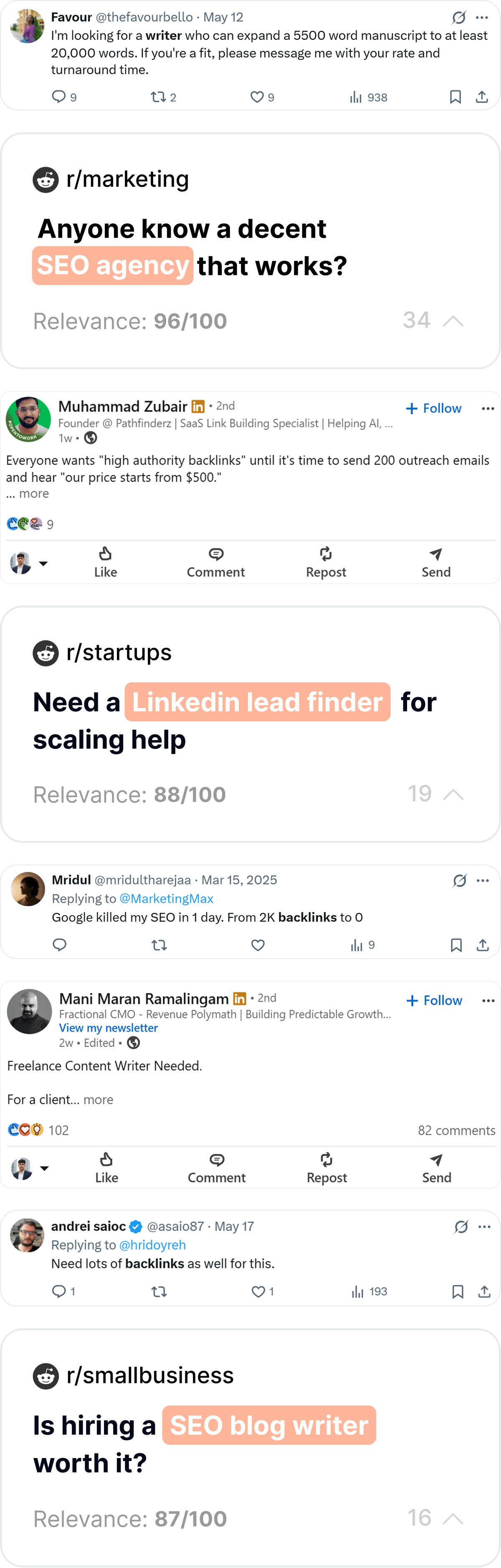
Here are the four categories of buying signals, with real examples of what they look like in the wild:
The three-filter system
Not all signals are created equal. When evaluating whether a post represents a real ICP lead, apply these three filters in sequence:
❌ Skip this post if...
- Bio shows they work at an agency or are a freelancer
- Post is purely venting with no call to action
- Account is very new with no history
- They're comparing tools they've already bought
- Zero engagement — possibly a bot or very niche audience
✓ Prioritize this post if...
- First-person ownership language ("my startup", "we launched")
- Specific numbers or timeframes mentioned
- Urgency words ("desperately", "finally", "need to fix this week")
- Price awareness ("budget around $X")
- Already tried other solutions and they failed
The Complete ICP Template for startups and SaaS founders
Use this template to document your ICP. Fill in every field — if you can't fill it in, that's a research gap you need to close before you start reaching out.
=== IDEAL CUSTOMER PROFILE ===
Version: [v1.0 — Date]
Product: [Your product name]
Last reviewed: [Date]

─── SECTION 1: WHO THEY ARE ───────────────────────────────

Company type:     [B2B SaaS / e-commerce / agency / etc.]
Company size:     [1–10 / 10–50 / 50–200 employees]
Revenue range:    [$0–$1M ARR / $1M–$5M ARR / etc.]
Funding stage:    [Bootstrapped / Pre-seed / Seed / Series A]
Geography:        [US / Europe / Global / specific region]
Industry:         [Specific vertical or 2–3 verticals]

ICP role (buyer): [Founder / VP Sales / Head of Marketing / etc.]
ICP role (user):  [Same as buyer? Or different?]
Decision maker:   [Who signs the PO?]
Budget authority: [Who controls the budget?]

─── SECTION 2: THEIR WORLD ────────────────────────────────

Tech stack:       [Tools they already use: CRM, analytics, comm, etc.]
Current solution: [What are they using to solve this problem today?]
Team structure:   [Solo? Small team? Dedicated function?]
Growth trajectory:[Flat / Growing 10%+ / Hypergrowth]

─── SECTION 3: THE PAIN ───────────────────────────────────

Core problem:     [One sentence: what specific problem are they experiencing?]
Frequency:        [How often does this problem occur?]
Business impact:  [What does this cost them in time / money / stress?]
Emotional impact: [How does this make them feel? What's at stake?]
What they've tried:[Prior solutions that failed, and why they failed]

─── SECTION 4: PSYCHOGRAPHICS ─────────────────────────────

Values:           [Speed? Quality? Control? ROI? Community?]
Risk tolerance:   [Early adopter / Pragmatist / Conservative]
Self-description: [How do they describe themselves? What communities?]
Ambition level:   [What's their 1-year goal?]
Buying style:     [Research-heavy or acts on gut? Needs social proof?]

─── SECTION 5: TRIGGER EVENTS ─────────────────────────────

Primary trigger:  [The event that makes them start looking NOW]
Secondary triggers:[2–3 other events that create urgency]
Buying window:    [How long from trigger to decision?]

─── SECTION 6: WHERE TO FIND THEM ─────────────────────────

Reddit:           [Top 3–5 subreddits they post in]
LinkedIn:         [Job titles to target / communities / hashtags]
Twitter/X:        [Accounts they follow / hashtags / communities]
Other channels:   [Slack groups / Discord / newsletters / events]

─── SECTION 7: YOUR PITCH TO THEM ─────────────────────────

One-liner:        [How you describe your product in their language]
Key proof point:  [The one stat or story that makes them stop scrolling]
CTA:              [What's the lowest-friction next step for them?]

─── NEGATIVES (who is NOT your ICP) ────────────────────────

Not a fit if:     [Company too large / too small / wrong stage]
Not a fit if:     [Wrong mindset / not in buying mode]
Not a fit if:     [Already committed to a competitor long-term]
The "negatives" section at the bottom of the ICP template is as important as everything above it. Knowing who is NOT your ICP saves you from chasing bad-fit customers who churn, demand refunds, and drain your support team — even if they initially pay.
Example: A completed ICP for an early-stage lead gen tool
=== IDEAL CUSTOMER PROFILE (filled) ===
Version: v1.0 — June 2026
Product: EarlyCustomers (lead-gen tool)
Last reviewed: June 2026

─── SECTION 1: WHO THEY ARE ───────────────────────────────

Company type:     B2B SaaS
Company size:     1–5 employees
Revenue range:    $0–$500 MRR (pre-revenue / early)
Funding stage:    Bootstrapped or Pre-seed
Geography:        Global (US, Europe, India primary)
Industry:         SaaS, Indie Hackers, Solopreneur tools

ICP role (buyer): Founder / CEO / Head of Growth
ICP role (user):  Same as buyer (solo or co-founder)
Decision maker:   Founder
Budget authority: Founder

─── SECTION 2: THEIR WORLD ────────────────────────────────

Tech stack:       Notion, Slack, Linear, Google Workspace, Gmail
Current solution: Manual Reddit / LinkedIn / X prospecting (scrolling, DMs)
Team structure:   Solo founder or 2-person team
Growth trajectory:Pre-revenue, trying to get first 10 customers

─── SECTION 3: THE PAIN ───────────────────────────────────

Core problem:     Spending 3+ hours/day manually searching Reddit
                  and LinkedIn for potential customers — with no system,
                  no tracking, and no way to know what's working.

Frequency:        Daily — this is their primary lead-gen activity
Business impact:  Missed deals, burnout, slow revenue, time wasted
                  on low-signal activity
Emotional impact: Desperate, overwhelmed, questioning if product is viable
What they've tried:Cold email (0 replies), posting in communities (banned
                  from one subreddit), ads (too expensive), referrals (none yet)

─── SECTION 4: PSYCHOGRAPHICS ─────────────────────────────

Values:           Speed, efficiency, validation, community trust
Risk tolerance:   Early adopter — willing to try unproven tools
Self-description: "Bootstrapped founder", "building in public", "indie hacker"
Ambition level:   Wants to hit $1k MRR within 3 months
Buying style:     Researches heavily on Reddit, wants social proof,
                  price-sensitive but will pay if it saves time

─── SECTION 5: TRIGGER EVENTS ─────────────────────────────

Primary trigger:  Week 4 of zero customers after launch — panic mode
Secondary triggers:Just got banned from a subreddit for "self-promotion",
                  just spent 3 hours on LinkedIn with no replies
Buying window:    Immediately — needs a solution this week

─── SECTION 6: WHERE TO FIND THEM ─────────────────────────

Reddit:           r/startups, r/SaaS, r/indiehackers, r/entrepreneur
LinkedIn:         Posts from "Founder" or "CEO" roles, companies size 1-5,
                  hashtags #startup #founder #bootstrapped
Twitter/X:        #buildinpublic, #indiehacker, #startup, #bootstrapped
Other channels:   Indie Hackers community, SaaS Discord servers,
                  Growth Hackers Slack

─── SECTION 7: YOUR PITCH TO THEM ─────────────────────────

One-liner:        "Stop manually hunting for leads on Reddit and LinkedIn —
                  we surface people already asking for your exact solution."
Key proof point:  "Founders using EarlyCustomers get their first 5 leads
                  within 24 hours."
CTA:              "Try it free for 7 days — no credit card required."

─── NEGATIVES (who is NOT your ICP) ────────────────────────

Not a fit if:     Agency or freelancer (they sell services, not products)
Not a fit if:     Series B+ company (they have dedicated SDRs and budgets)
Not a fit if:     Looking for ads, not organic (they want to run Facebook ads)
Not a fit if:     Non-technical founder with no product built yet
From ICP to first paying customer — the complete bridge
Having a great ICP is only half the work. The second half is using it to find real people and convert them into customers — without a big team, a big budget, or months of runway left to waste.
The 4-week first-customer sprint
Week 1: Build your ICP — then go find 50 of them
Complete the ICP template above. Then go to Reddit, LinkedIn, and Twitter and find 50 people who match it and are currently expressing a problem you can solve. Don't reach out yet — just collect. Use EarlyCustomers.com to automate this step: paste your URL and get a feed of high-intent leads immediately.
Week 2: Engage — don't pitch
Reply to 20 of those posts with genuinely helpful content. Answer their question thoroughly. Share a resource. Give away your best advice for free. Don't mention your product. The goal is to be helpful enough that they visit your profile and reach out, or that when you DM them, they already know who you are.
Week 3: Direct outreach to your top 10
From your 50, select the 10 with the highest buying intent. Send them a direct message — not a pitch, but an offer to help. Reference the specific post they made. Offer something of value (a free audit, a custom resource, a quick call where you share your findings). The message should be about them, not you.
Week 4: Close, learn, and iterate your ICP
Run discovery calls with everyone who responds. Focus 70% of each call on understanding their situation, not pitching your product. Close the ones who are a fit. For the ones who aren't, ask why — the answer updates your ICP. By end of week 4, you should have your first paying customer and a much sharper ICP.
How EarlyCustomers.com makes this 10× faster
The 4-week sprint above works. But it involves a lot of manual searching, filtering noise, and monitoring multiple platforms simultaneously. EarlyCustomers.com is built specifically to automate the hardest parts:
- Auto ICP generation — paste your URL, get an intent graph and ICP hypothesis in minutes, not weeks
- Cross-platform lead discovery — find high-intent posts from Reddit, LinkedIn, and X in one dashboard, scored by buying intent
- Competitor tracking — get notified the moment someone mentions your competitor and is looking for alternatives
- AI-drafted replies — for every lead, get a platform-native reply drafted for you that sounds helpful, not promotional
- Real-time alerts — never miss a high-intent post; get notified the moment someone who matches your ICP posts
- Lead relevancy scoring — every lead is scored and explained so you know where to spend your limited time
Stop guessing who your ICP is. Let your future customers tell you.
EarlyCustomers.com finds people already posting their problems on Reddit, LinkedIn, and X — people who match your ICP and are ready to buy. Start free, no credit card needed.
Find My ICP & First Customers → See pricing