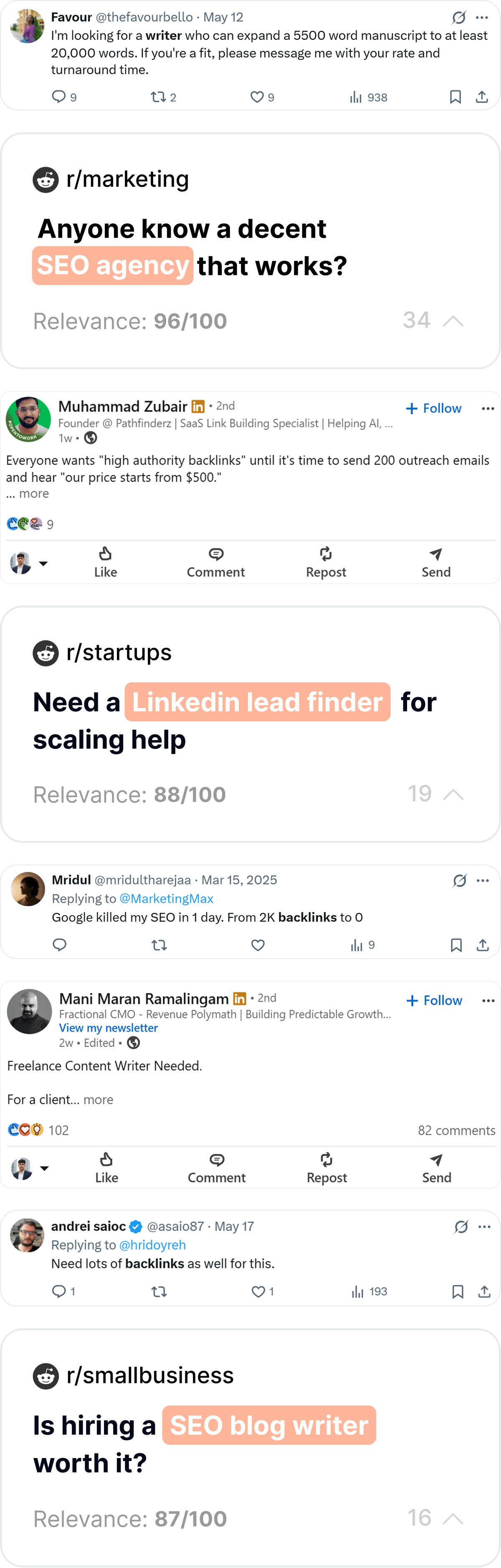
Why X is the most underrated B2B lead source for early-stage founders
Most founders treat X/Twitter as a broadcast channel — they post about their product and wait for customers to appear. The founders who actually use X to get customers do something entirely different: they listen first, engage second, and pitch almost never.
X has a unique property that Reddit and LinkedIn don't: radical transparency in real-time. People say things on X they'd never say in a professional LinkedIn post or a formal survey. They express frustration, share half-formed thoughts, vent about tools that don't work, and ask for help in the moment they need it — not after they've carefully crafted a professional question.
This makes X the richest source of raw, unfiltered buying intent on the internet. The challenge is that it's also noisy, ephemeral, and moves fast. If you don't have a system for monitoring it, the signals disappear before you can act on them.
X vs Reddit vs LinkedIn for early-stage lead generation
| Factor | X / Twitter | ||
|---|---|---|---|
| Signal freshness | Real-time (minutes) | Recent (hours/days) | Slower (days/weeks) |
| Professional context | Medium (bio + handle) | Low (often anonymous) | Very high (full profile) |
| Outreach options | Reply, DM, Quote | Comment, DM | Comment, DM, InMail |
| ICP density (for SaaS/founders) | Very high (#buildinpublic) | High (niche subreddits) | Medium (role-specific) |
| Spam risk | Medium | High (shadowban risk) | Medium |
| Response window | Very short (2 hrs) | Days | Days |
The table tells the story: X has the shortest response window but the most real-time signal density — especially if your ICP is early-stage founders, SaaS builders, or tech-forward professionals. The urgency is the challenge and the opportunity simultaneously.
X works best as a lead generation channel when your ICP is tech-forward, startup-adjacent, or founder-focused. If you're selling to enterprise procurement teams or highly regulated industries, LinkedIn will outperform X. But for anything in the SaaS, tools, creator economy, or startup ecosystem — X is irreplaceable.
The 2-hour window: X's biggest competitive advantage
On X, time is everything. A tweet asking for tool recommendations lives in active conversation for roughly 2 hours. After that, the original poster has gotten their answers, moved on, and the opportunity is gone. This urgency is what makes X different — and what makes real-time monitoring non-negotiable.
Why the first reply wins disproportionately
When someone posts "Looking for a tool that does X — any recommendations?" on X, the replies come in a rush in the first hour. By the second hour, the conversation is winding down. By the sixth hour, the post is buried in their timeline and they've already DM'd someone who replied early.
The first few replies get enormous advantages:
- Visibility — replies are sorted by algorithm weight, but early replies from real accounts typically surface at the top of the thread
- Recency — the poster is actively checking replies in the first hour; after that, they're doing other things
- Anchoring — the first thoughtful answer frames the conversation; everyone who replies after is responding to your response, not just to the original post
- DM opportunity — people who get a great public reply are much more likely to DM for more — which is where the real conversation (and sale) happens
Being first matters — but only if your reply is good. A generic first reply ("Check out [Your Product]!") is worse than a thoughtful reply 90 minutes later. The goal is to be the first genuinely useful reply. That combination — early AND helpful — is what converts leads into customers on X.
Why manual monitoring doesn't work
You can't be on X watching for intent signals 14 hours a day. You have a product to build. Even with X Lists and search bookmarks, you'll miss half the high-intent posts in your problem space because they happen at unpredictable times throughout the day and night.
This is the core limitation that EarlyCustomers.com solves for X: real-time monitoring of your keywords and ICP signals across X, with instant alerts the moment a high-intent post appears. So instead of checking X every hour hoping to catch something, you get notified exactly when to act — within minutes of the post going live.
The #buildinpublic ecosystem: the most concentrated early-stage buyer community on the internet
If your ICP is early-stage founders, indie hackers, or bootstrapped SaaS builders — the #buildinpublic community on X is the single highest-value lead source you'll ever find. Here's why, and how to use it.
What makes #buildinpublic different
#buildinpublic is a cultural movement on X where founders share their journey publicly — revenue numbers, user counts, mistakes, wins, and the tools they use. It's radically transparent by design. This means:
- They share their exact problems — "Week 8 update: still can't find a reliable way to track where my sign-ups come from" is a live buying signal with full context
- They signal what stage they're at — "$0 to $1K MRR this month" tells you exactly what kind of buyer they are
- They actively seek tools — the community culture is collaborative; asking for tool recommendations is normal and expected
- They have engaged audiences — popular #buildinpublic accounts have thousands of followers who are also in the ICP; one relationship opens doors to dozens
- They give honest feedback — if your product doesn't work, they'll tell you publicly; if it works brilliantly, they'll share that publicly too (word-of-mouth built in)
The key communities and hashtags in the ecosystem
Core Founder Community
The flagship hashtag. Founders at all stages share updates, wins, struggles. Highest-volume for founder ICP signals.
Very high intentBootstrapped Builders
Specifically bootstrapped founders. Higher price sensitivity but extremely engaged; tool recommendations spread fast.
High intentSaaS Founders & Teams
Broader SaaS community including funded startups. More diverse but excellent for B2B SaaS tools targeting founders.
Medium-highStartup Ecosystem
Wide community of founders, investors, operators. Good for awareness but less concentrated than #buildinpublic.
MediumGrowth Marketers
Marketing and growth teams actively experimenting with acquisition channels. High buying intent for growth tools.
High intentCompetitive Communities
Users of competitor tools who may be open to switching. Search for #[competitor] with negative sentiment keywords.
Very high intentFounders in #buildinpublic post "milestone updates" regularly: "Week X of building in public." These posts contain exact data on where they are — MRR, user count, biggest challenge. Read these posts carefully. The "biggest challenge this week" section is often a direct buying signal. Someone posting "Week 12 — still struggling with finding paying customers" is a perfect prospect for EarlyCustomers.com.
Advanced X search operators: find exactly who you're looking for
X's search is more powerful than most founders realize. With the right operators, you can narrow 500M daily posts down to the 20 that are directly relevant to your ICP right now.
The complete X search operator toolkit
BASIC OPERATORS:
"exact phrase"            — Only results with exact phrase
word1 OR word2            — Either word
word1 -word2              — Exclude word2
#hashtag                  — Posts with this hashtag
from:username             — Posts from specific account
to:username               — Replies to specific account

ENGAGEMENT FILTERS (very useful for intent scoring):
min_faves:10              — Posts with 10+ likes (resonated with audience)
min_replies:3             — Posts that sparked conversation
min_retweets:5            — Posts others amplified

TIME FILTERS:
since:2026-06-01          — Only posts after this date
until:2026-06-07          — Only posts before this date
(use both for a specific week of posts)

LANGUAGE AND LOCATION:
lang:en                   — English only
near:"San Francisco"      — Geolocated posts (limited accuracy)

CONTENT TYPE:
-filter:links             — Removes promotional/linked content; surfaces genuine conversation
-filter:replies           — Only original posts (not replies)
filter:replies            — Only replies (useful for mining comment threads)
High-value search combinations for lead generation
Find people looking for your category:
"looking for" "[problem/tool type]" -filter:links

Find frustrated competitor users:
"[competitor name]" (frustrated OR switching OR "doesn't work" OR hate) -filter:links

Find the #buildinpublic + your problem:
#buildinpublic ("[your problem]" OR "struggling with" OR "can't find")

Find evaluation/comparison posts:
"[Competitor A]" OR "[Competitor B]" "which is better" OR "vs"

Find urgent buyers (deadline language):
"[problem]" ("need to" OR "asap" OR "by next week" OR "launching soon") -filter:links

Find peer recommendations (very high trust context):
"[problem]" ("what do you use" OR "what tools" OR "any recommendations") min_faves:5

Find post-launch problem posts:
"just launched" OR "went live" ("[problem you solve]") -filter:links
Building your X monitoring dashboard
The best way to use X search for ongoing lead generation is to save your highest-performing searches and check them systematically. Here's a monitoring rhythm that works:
Check your highest-intent keyword searches
Your top 3–4 search strings that consistently produce high-quality leads. Check these morning and late afternoon. Posts from the last 12 hours only — sort by "Latest." Anything older than 24 hours is too old for X outreach.
Check your competitor monitoring searches
Any posts mentioning your competitors with negative sentiment. These have a slightly longer window than general problem posts — someone frustrated with a competitor may still be in consideration mode for 3–5 days, not just 2 hours.
Scan your ICP's recent posts for ICP refinement
Look at the profiles of people who engaged with your recent replies or posts. What else are they posting about? This ongoing profiling continuously sharpens your understanding of your ICP's language, fears, and aspirations.
Or skip the manual monitoring entirely. EarlyCustomers.com runs all these searches continuously and alerts you the moment a matching post appears — so you can respond within the 2-hour window without spending your day on X.
Reading intent signals on X: what to look for and why it matters
Not every X post about your problem space is worth engaging with. Learning to read intent signals quickly — in 10 seconds or less — is what separates high-converting X outreach from a wasted afternoon.
The anatomy of a high-intent X post
Week 8 of building in public: hit 23 free users this week 🎉
But honestly struggling with the thing I thought would be easy: finding paying customers. Have tried cold email (0 replies), posted in 2 subreddits (1 got removed), and DM'd 15 people on LinkedIn (3 replies, 0 interested).
Is this just the founder tax or is there a smarter way to approach this? What actually worked for you in the early days?
#buildinpublic #indiehacker #SaaS
This post has every high-intent signal stacked:
- Specific problem statement — not "finding customers is hard" but "here's exactly what I've tried and what happened"
- Urgency through stage context — week 8, 23 free users, zero paying — a clear timeline and pressure point
- Has already tried alternatives — eliminates the "just try cold email" reply as a useful response; sets a higher bar for what counts as help
- Asks for specific help — "what actually worked for you" is a direct invitation to engage
- Community tags — #buildinpublic confirms ICP; #SaaS confirms the product type
- Engagement already starting — 8 replies means active conversation; jump in now before it gets crowded
Intent level scoring: the quick 3-question test
For every post you find, run this 3-second mental test:
❌ Skip this post if...
- The problem is hypothetical or general
- The person is clearly a student or researcher
- The post is older than 48 hours
- The poster is in a completely different industry/stage
- The post already has 20+ replies (crowded)
✓ Engage immediately if...
- Specific problem with specific context
- Clear professional role or stage signal
- Posted within the last 2–4 hours
- Has urgency language (deadline, frustration, "right now")
- Under 10 replies (you can still be impactful)
Engaging leads on X without being spammy
The cardinal sin of X outreach is treating it like cold email. X is a public conversation — not an inbox. How you engage in public determines whether people see you as a valuable voice or a spammer to be blocked.
The golden rule: give first, promote never (in public)
Every public reply to a high-intent post should be 100% useful with 0% promotional. The moment you start a reply with "I built a tool for exactly this—" you've lost 90% of the potential impact. Here's why:
Jumping straight to a product recommendation signals two things: you didn't read their post carefully enough to understand the nuance of their situation, and you care more about promoting your thing than actually helping them. Both interpretations kill trust instantly.
Instead, engage like an expert:
Answer the actual question — thoroughly
If someone asks "what worked for you in the early days to find customers", answer the question with real, specific advice. Share something from your experience. Give a framework. Link to a relevant resource (your free guide, a third-party article). Be the most useful reply in the thread.
Validate their experience before you add anything
"What you're describing is incredibly common and it's genuinely hard" before you pivot to advice. People on X respond well to feeling understood, not just informed. One sentence of validation before your advice makes the whole reply land better.
Only mention your product if it's genuinely the most relevant thing in your reply
If you've given 3 great pieces of advice and your product is the most efficient way to implement one of them, you can mention it as a footnote — "we actually built EarlyCustomers.com to automate exactly this part." A footnote mention after genuine advice converts. A cold pitch as the first sentence doesn't.
Move the real conversation to DMs
After a helpful public reply, send a short DM: "Hey — noticed you're dealing with [specific aspect of their problem]. Happy to share a bit more detail that I didn't want to write out publicly. No pitch." This transition from public reply to private DM is where the actual sale conversation begins.
Every great public reply on X builds your reputation in the community. When you consistently give the best answers in your problem space, two things happen: people start following you (inbound leads), and when you do mention your product, it's received with a baseline of trust rather than skepticism. The compounding effect of 90 days of excellent replies is remarkable.
Twitter DM templates that actually get replies
X DMs are more casual than LinkedIn messages and have a shorter attention span. They need to be concise, specific, and warm — not copy-pasted and formal.
Template 1: After a public reply (the most natural transition)
Hey [Name] — replied to your post about [topic].

Wanted to add one thing I didn't write publicly: [one specific, concrete
piece of advice or context that's genuinely useful and too detailed for a
public reply].

Happy to share more if helpful. No agenda, just building in the same space.
Template 2: Direct to a high-intent post (no prior engagement)
Hey [Name],

Saw your tweet about [their specific problem]. I've been deep in this exact
problem for [X months] — here's the one thing that unlocked it for us:

[One genuinely useful insight — a framework, a finding, a resource — that
addresses their specific situation]

If you want to dig into [specific aspect] further, happy to share what
we've found. Zero pitch — just building in the same space and this seemed
directly relevant.
Template 3: The competitor frustration DM
Hey [Name],

Noticed your tweet about [competitor] — that [specific frustration] is
something we hear a lot and it's actually why we built [your product].

Not trying to pitch you. But if you're genuinely looking for an alternative
that handles [specific thing they mentioned], worth a 10-minute look.

Here's a [link to demo/relevant guide/case study] if curious — otherwise
totally fine.
Template 4: The #buildinpublic milestone response
Hey [Name],

Read your week [X] update — the [specific thing they said, e.g., "0 paying
customers after 8 weeks" or "struggling to convert free to paid"] really
resonated.

We went through the same wall around week [similar week]. The thing that
broke it open for us was [one specific tactical thing].

Happy to share the full playbook if you're at that stage — built
EarlyCustomers.com partly because I couldn't find a good guide to this
when I needed it.
Send DMs within 1–2 hours of the post that triggered them, ideally after leaving a public reply first. The combination of "thoughtful public reply + follow-up DM with more detail" is significantly more effective than cold DM alone, because the person already has a positive impression of you from your public contribution.
Building your X presence for inbound lead generation
Outbound X engagement gets you leads this week. A strong X presence gets you leads every week indefinitely — without you having to initiate every conversation.
The 3-layer X content strategy for founders
Problem-space content (attracts your ICP)
Post about the problem your customers have — not your solution. "Why most founders can't find their first 10 paying customers" attracts the exact people you want. Share observations, patterns you see, counterintuitive insights. The goal is to become the account people follow when they have your problem. Post this 3×/week minimum.
Building-in-public updates (builds trust through vulnerability)
Share your own journey openly — what's working, what's not, what you're learning. The #buildinpublic community responds powerfully to authenticity. Founders who share their real numbers, their failures, and their pivots attract other founders who want the same honest community. Post weekly updates with real metrics.
Expertise signals (establishes credibility)
Post tactical threads, frameworks, and how-tos that demonstrate you deeply understand your problem space. "Thread: The 5 intent signals that tell you someone is about to buy — and how to find them on Reddit" is the kind of content that gets bookmarked, shared, and that your future customers will reference when deciding whether to trust you.
Profile optimization for lead generation
- Bio should be a value proposition — "Helping founders find their first paying customers without cold lists | Building @EarlyCustomers" is better than "Founder. Builder. Startup enthusiast."
- Pin your best content — pin a thread, a resource link, or a post that demonstrates expertise and starts converting visitors into followers
- Reply consistently in your niche — the algorithm amplifies accounts that engage actively in relevant conversations; your replies are as important as your posts for growing a relevant audience
- Link to your free resource in bio — a free guide, checklist, or tool that's immediately useful to your ICP converts profile visitors into email subscribers or product trial users
- Post at peak engagement times for your ICP — for the #buildinpublic community, weekday mornings (8–10am EST/PST) and Sunday evenings tend to have the highest engagement
From X lead to your first paying customer
X warms the relationship. The close happens in the DM or on a call. Here's how to bridge the gap without losing the momentum that X creates.
The X-to-customer conversion sequence
Public reply → DM → value exchange
The funnel starts with a public reply that demonstrates you understand their problem. Your DM follows with something more specific — a resource, a more detailed answer, an offer to share your experience. The goal of the DM is not to sell; it's to start a real two-way conversation. Ask a question. Share something useful. Keep it human.
DM conversation → low-stakes offer
After 2–3 exchanges in DMs, the relationship is warm enough for a low-stakes offer: "Would you want to see what we've built for exactly this problem? Takes 5 minutes." Or even lower stakes: "I could send you a Loom walkthrough — you can watch whenever, no call required." The lower the friction, the higher the conversion.
Loom or async demo → call or trial
A 3–5 minute Loom personalized to their specific situation ("Hey [Name] — this is for you specifically based on what you said about your [problem]") converts much better than a generic product demo. If they watch it and reply with questions, offer a call. If they seem ready, offer a trial. Match the next step to their level of engagement.
Close by solving the specific problem they posted about
Your product should be presented as the answer to the exact problem they tweeted about — not your product in general. "This is exactly how we'd solve the [specific thing they mentioned in their tweet]" is a close. "We can help with all kinds of lead generation challenges" is not a close. Specificity sells on X because the relationship started with specificity.
How EarlyCustomers.com makes X lead gen systematic
The manual version of X lead generation — monitoring multiple searches, checking for new posts every hour, sending timely replies — is unsustainable at the speed X requires. EarlyCustomers.com automates the infrastructure so you can focus on the conversations:
- Real-time X keyword monitoring — track your problem keywords and get alerted within minutes of a high-intent post appearing
- Intent scoring for every X post — each post is scored so you know which ones warrant immediate action vs monitoring
- AI-drafted reply suggestions — get a contextual, non-promotional reply drafted for each high-intent post so you can engage in the 2-hour window without spending 20 minutes crafting a response
- Competitor mention alerts — know instantly when someone mentions your competitor with frustration on X — the highest-intent lead type on the platform
- #buildinpublic tracking — filter specifically for #buildinpublic posts that match your ICP profile and problem space
- Cross-platform ICP correlation — the same person who posts on X often posts on Reddit too; EarlyCustomers surfaces when your ICP appears across multiple platforms
X leads have a 2-hour window. Don't miss them.
EarlyCustomers.com monitors X in real-time and alerts you the moment a high-intent post from your ICP appears — with an AI-drafted reply ready to send. Stop refreshing X manually. Start converting the leads that actually matter.
Get Real-Time X Alerts → See pricing